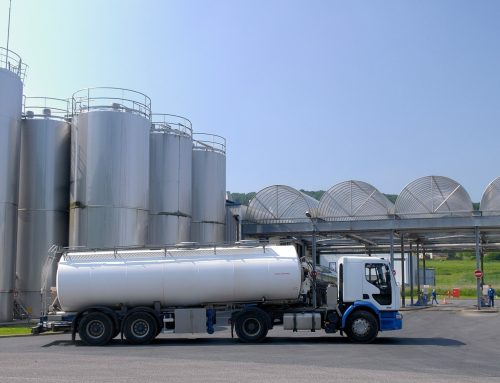
A truck pulls up at the gate at 6:40. The driver climbs down, rings the bell, then waits. Someone eventually opens up. He hands over a paper delivery note, the operator looks up the reference, then points him towards the weighbridge. Two vehicles are already ahead of him. He weighs in. The operator retypes the weight and the registration into a spreadsheet. He is finally directed to a bay, which turns out to be occupied. He waits again, he loads, he weighs out. More retyping. He leaves at 8:55.
In short, two and a quarter hours for a twenty-minute job.
None of this is unusual, however. According to the 2024 Long Distance survey by the French National Road Committee (CNR), waiting time to load or unload falls between one hour and two and a half hours in 90% of cases. On average, the CNR records one hour thirty-two minutes at loading and one hour thirty-three at unloading.
The striking part lies elsewhere: none of that time shows up anywhere. It does not reach production reporting. It does not enter the calculation of overall equipment effectiveness. In other words, nobody on the site owns the job of measuring it.
What waiting time actually costs
The cost is diffuse. That is precisely why most sites underestimate it.
First, the haulier pays, and then you do. Waiting counts inside the driver’s paid working time. The CNR documents the mechanism clearly: the longer it runs, the smaller the share of driving in paid hours, and the heavier the overtime premium on the cost of operating the vehicle. Hauliers therefore build that idle time into their rates. The extra cost comes back to you at the next round of negotiation, without anyone identifying it as such.
Second, it ties up staff on work that creates nothing. Someone opening a gate, hunting for a delivery note, retyping a weight and directing a driver is doing necessary work, but entirely mechanical work.
It also creates risk on site. Heavy goods vehicles parked along a traffic route, drivers stepping down from the cab and walking through a plant yard where loading shovels operate: every health and safety manager knows the picture, and none of them is comfortable with it.
Traceability suffers as well. When an operator retypes a weight by hand, they can get it wrong. In a dispute over a delivered quantity, the evidence then rests on a spreadsheet and on the memory of whoever was on shift that day.
Finally, it spills over into production. A blocked bay means stock that does not move, silos that fill up, and occasionally a line that has to slow down.
Consider the order of magnitude. A site handling 80 vehicles a day, with an average of one hour of waiting, accumulates 80 hours of idle time every day. Annualised, the figure becomes hard to ignore.
Why the problem stays invisible
Quite simply because every step, taken on its own, looks reasonable.
Five minutes at the gate is nothing. Ten minutes at the weighbridge is normal. A quarter of an hour spent finding the right person happens. Twenty minutes at the bay is industrial life.
It is the sum that hurts. Yet nobody adds it up, because nobody measures it. The driver measures it, of course: he absorbs the whole chain. He has no channel to report it, however, beyond complaining at reception.
The first benefit of digitalisation is therefore not fluidity but visibility. The day a site manager first sees the curve of time on site per vehicle, with its hourly peaks and its bottlenecks, the conversation changes character entirely.
Nothing has shifted in a decade, incidentally. The CNR measured three hours twelve minutes of combined loading and unloading waiting time in 2014. In 2024, it measures three hours nine.
The five friction points
On most sites, delay collects in the same places every time.
- Arrival: Trucks turn up when they can, usually all at once. Without planning, the load therefore concentrates into two or three peaks while the site sits empty for the rest of the day. The CNR is explicit here: waiting time depends not on distance travelled but on organisational factors, starting with whether the customer books slots.
- Access control: Identifying the driver, checking the authorisation, raising the barrier. When someone does this by hand, it occupies a dedicated post and creates a bottleneck at every peak.
- Weighing: Every vehicle has to cross the weighbridge. Mechanically, that is where the queue forms. It is also where data reliability is decided.
- Data entry: Retyping the weight, printing the ticket, pushing it into the ERP: each handling step adds delay and one more chance to make a mistake.
- Coordination with operations: Knowing which bay is clearing, which product is available, who is loading. When that information travels by phone or two-way radio, it travels badly.
Digitalising without replacing everything
This is exactly where most projects come unstuck: they try to change everything at once.
An approach that works builds on what is already there instead. The weighbridge stays where it is, but its operation becomes automatic. Reception keeps its purpose, minus the manual steps. The ERP remains the system of record, except that it now fills itself.
Here are the building blocks, in the order that usually delivers the most:
- arrival planning, through slots hauliers book themselves, which smooths the load and removes much of the queue before it forms;
- automatic vehicle identification, by badge, QR code, RFID or number plate recognition, which frees up the manual checkpoint;
- self-service driver kiosks, which let the driver check in alone, in their own language, without hunting for anyone;
- automated weighing, capturing the reading directly, timestamping it and issuing the ticket;
- access and traffic control, through barriers, signals and displays that route the vehicle to the right bay at the right moment;
- interfacing with existing systems (ERP, production management, SCADA), so that your teams enter the data only once.
Above all, each block stands on its own. You can therefore roll out in stages, with a measurable result at every step, rather than launching an eighteen-month programme whose effect you will not see until the end.
What changes in practice
Take the same truck, with the system in place. The driver has booked a slot, arrives at the expected time, the system reads the plate, the barrier lifts. He checks in at the kiosk, a display routes him to a free weighbridge, the system weighs and timestamps, the ticket prints itself, the data flows to the ERP. He then goes straight to an available bay.
The gatehouse operator has not disappeared. He does something else instead: he handles exceptions, non-conformities, visitors, in short every situation that genuinely needs a human.
Beyond time, traceability changes for good. The system timestamps every movement, ties every weighing to an identified vehicle and archives every ticket. In a dispute, the answer takes one search.
Four questions to ask before starting
- Do you know how long a truck actually spends on your site? If the answer is no, start by measuring it, even by hand for a fortnight.
- How many times do your teams enter the same information? A registration number retyped by three different people is the most reliable symptom of a process ready for digitalisation.
- Who owns the subject on site? These projects cut across logistics, production, safety and IT. Without a clearly named owner, they stall between departments.
- Which constraint cannot move? A single weighbridge, a fixed yard layout, imposed opening hours. The solution has to be built around that constraint, not the other way round.
A problem well beyond heavy industry
Truck flow management is instinctively associated with cement plants and quarries, since those sites receive the most vehicles. The problem is identical, however, wherever a site combines a weighbridge, several loading points and third-party hauliers.
Waste transfer stations and sorting facilities, for example, combine high vehicle volumes with tonnage traceability that regulation enforces. The same applies to builders’ merchants and aggregate depots, to food processing plants with their upstream traceability requirements, to metal processing works, and to chemical sites, where controlling heavy goods vehicle access is also a safety matter.
In every one of those cases, the starting point is the same: a driver waiting, and information somebody retypes.
How IBITEK approaches these projects
IBITEK is an industrial engineering firm and systems integrator founded in 2007, operating across six countries in the EMEA region. We work along the full chain, from the electrical installation and automation through to supervisory software. As a result, we treat a truck flow project as what it really is: a logistics, electrical, automation and IT subject at the same time.
Our truck flow management solution automates check-in, access control, weighing and vehicle tracking. It also interfaces with the systems already running on site, and it deploys in stages, starting with the friction point that costs the most.
Want to know what your waiting times actually cost? Let’s talk about how your site is organised and what you could realistically recover, step by step.